
Category Archives: Uncategorized

Episode 84: Stop Job Seeking and Start Networking | Tom Dowd, aka Transformation Tom, author of Displacement Day

Thomas Dowd talks about networking when you are job seekingThomas Dowd is the author of his book, Displacement Day. It’s about trying to recover from losing a job and going out job hunting. One of the things that I thought was very interesting was the way he would go about job seeking and how he recommends others do it as well. It’s the difference between networking and job searching.

Thomas Dowd, or Transformation Tom, is the author of “Displacement Day: When My Job was Looking for a Job…A Reference Guide to Finding Work.” With over twenty-three years of experience in the financial industry in management and leadership roles at the same organization, Thomas Dowd received the call nobody wanted: “We’re downsizing.” What could have been a devastating day, immediately turned into a journey toward his next book “Displacement Day.”

Zeb’s Take – Networking while Job Seeking

I really liked the fact that he brought up how to go about finding a job. Recently, I’ve been approached by a couple people who tell me that they’re looking for jobs. When they come up to me and they ask, “Hey, I’m looking for a job. I don’t have a job. Is there anything that I can do?” Desperately I want to try to help them in some capacity, but it’s tough to think of a way to do that. Sometimes I think of people that I might know to put them in touch with.

What Tom brought up in the interview was that instead of being a job seeker, instead of asking people for jobs all the time. Which actually can be kind of a weird feeling, because the person you’re asking, it feels a little uncomfortable because they want to help, but they can feel like they are in control of your destiny… it’s a lot of pressure and makes it a more uncomfortable conversation, I think. Where, if you look at it as you are networking with someone who could potentially give you a job, and not so much like, “hey I need a job, give me a job.” Instead, going in there and asking asking them questions about their business, what is it that they well, how do people get that job, how do they excel in that industry. By asking those questions it’s more of a relationship where you have two people engaging and discussing together. It’s more comfortable for the other people involved. It’s really a great way to think about job seeking and looking for jobs.

In the interview I mentioned that I went around the country, and check out Craigslist and just blast my resume out everywhere. Say, “Hey, I need a job! I need a job! I need a job!” I’m telling everyone, and it didn’t work for me. If I had gone about it differently and I had looked for ways to network with those people I think I would have had better results.

If you are looking for a job, follow Tom’s advice.

Now, go out there and find your success!

Find Out More About Tom Down and His BookThomas Dowd's book Displacement Day

Go to TransformationTom.com

Tom’s book, Displacement Day: When My Job Was Looking for a Job, is available in regular book form and ebook form on Amazon. Just search for the title “Displacement Day.”


Quotes

  • “It wasn’t my communication skills, it was actually my confidence level. By gaining this confidence I learned to communicate much more effectively.”
  • “It’s not about getting the project done. It’s about building the right relationships with the right people to get the job done.”
  • “When I stopped trying to impress and start being myself I gained the confidence, I gained the skills, and I found a whole lot more success.”
  • “I had built the network, I felt really good about it, and I built it before I needed it.”
  • “Networking isn’t just checking off a box. It’s about building a true relationship. A mutual relationship.”
  • “Stop job seeking and start networking.”
  • “In these networking sessions, never leave it without asking the question, who else can I meet with? And run with it.”
  • “The important part of the network is that you start the process, but the network does the work for you if you allow it to.”
  • “As soon as I became a better teacher I became a better learner. By becoming a better learner I became a better teacher.”
  • “I believe in who I am, and more importantly, I believe in who I can still be.”

Dowd2      TomDowd

More From the Interview

Tom was a communications major at the University of Delaware. He graduated on a Friday and started work at a Finance company on a Monday. Worked there in several positions for over 23 years. When his company was taken over and went from a 28,000 person organization to a 300,000 person organization, he had to make a mental adjustment: decide if he was going to be swallowed up in the 300,000 person organization or did he want to make a difference. He joined Host Masters, a worldwide organization that helps to improve communication skills and leadership skills, it was that that boosted Tom’s confidence through the roof. It allowed him to do things within his own professional state, and within the organization to make a difference in the organization. He wrote a couple books while he was at that job. One was on his own transformation of becoming self aware and the other on public speaking.

“I was told for 18 years on my performance appraisals that I couldn’t communicate I was told that I have some issues with those skills: listening, yapping, not being clear/concise, not being confident in how I communicated with senior leaders. So I ended up joining Toast Masters, I found during a time, it wasn’t my communication skills, it was actually my confidence level. By gaining this confidence I learned to communicate much more effectively.”

In Toast Masters, he competed in these speech competitions. Twice he got as far as one speech away from the world semi-finals. He met many people who helped him in his journey of communication, confidence and leadership. He gained mentors. One of whom inspired him to write about leadership, success, and how to be a better speaker.

Screen Shot 2014-06-03 at 8.47.03 AM

“I became much more successful when I learned to be myself. Which believe it or not is where my confidence came from. I found myself trying to impress so many people at my job. When I stopped trying to impress and start being myself I gained the confidence, I gained the skills, and I found a whole lot more success.”

To clarify what he means by “Being Yourself.” He was learning to build trust and build relationships. Tom compares his work-self to his home-self. There’s the Tom who is sitting at the dinner table having a conversation with his family, laughing, joking, casual. It’s not about communication or confidence, it’s just being Tom. And then he goes to work, has a tie choking him around the neck, a white collar, get the job done, force the hand of the people around him, give them critical feedback whether they want it or not, who never missed his goals, never missed hitting his numbers.

He got lots of criticism. There were a few people who gained his trust. One of them talked to him and asked him about his relationships with the other people at the company. It helped him realize things he needed to change. He had a reputation as an uptight guy who gets the job done, but people were concerned about his leadership abilities.

Once a month he would pick up the phone and talk to somebody he didn’t know, and who were a couple levels above him in the organization. To push his comfort zone and to reinventing himself. He would tell them about what he’s been doing at the organization and what they’ve been doing. How they could maybe help each other. He became a better listener, a better business partner, became more successful because he stopped trying to impress people and just worried about the job. The people became more important to him.

“I became this push and pull man. I’m gonna push you when you need it and I’m gonna pull you in and figure out what you can do to help yourself.”

“It’s not about getting the project done. It’s about building the right relationships with the right people to get the job done.”

“I was trying to change people. What I really needed to do was change me to be who I wanted to be while still getting the best out of people.”

When he found out his company was downsizing, he said that phone call was almost calming. He has such confidence in the network he built, in the skills he had, in his vulnerability to learn from his mistakes and develop who he wanted to be, he says he saw the whole world ahead of him and said, “Okay.” He wasn’t worried.

“I had built the network, I felt really good about it, and I built it before I needed it.”

“Networking isn’t just checking off a box. It’s about building a true relationship. A mutual relationship.”

“Stop job seeking and start networking.”

Tom stopped asking for a job and started working to build his relationships with people in his network. He had to reinvent himself to them so they would know what he was looking for. Also, he says one of the biggest things he learned was don’t make assumptions. Because he assumed that people in his network, certain people, would support him – drop everything they’re doing to give Tom advice, give him a direction, a path. That wasn’t always the case He realized that they were too close to him. They knew exactly what he wanted and what he didn’t want. It was the secondary network, people who knew people, who had new conversations with Tom about what are you looking for? what do you want? and that led to the first chapter of his book.

By talking to his secondary network Tom realized that maybe he didn’t need to go back into the financial industry. Another assumption. He had the speaking stuff, this coaching, this training world that maybe he could turn into a job.

If you’re networking, instead of job seeking, there is no expectation. It takes the pressure away from the situation so they won’t shy away.

Tom says to have an elevator speech, whether you’re employed or not. Think about what do you want people to know about you. What is your greatest accomplishment. Have a 2 min, 5 min, 10 min version of who you are that you can share.

“In these networking sessions, never leave it, without asking the question, who else can I meet with, and run with it.”

Tom says, that’s when you see the spiderweb of network.

“The important part of the network is that you start the process, but the network does the work for you if you allow it to.”

That’s where you move past sympathy and into action.

He says, I had a little credibility issue as I was trying to coach and train people on how to write resumes and network while I was unemployed. I continued to do that while I was job seeking. I talked to people that had been looking for jobs for over two years. I found a lot of people who would not apply for a job because they met a few of the requirements, but they did not quite meet everything within the job description. He says the hiring manager put down the absolute perfect candidate, probably no one is going meet everything on that job description. He also recommends that have to differentiate yourself, all resume’s look the same. Make your story come alive. Your resume should read like a book. It is the introductory chapter, make people want to read the rest of the book.

“People are just too vanilla in their resumes.”

People always get frozen in these situations.

Always have a plan. Wake up like you have a job. Have a plan of attack for the day. Send emails, make phone calls, schedule and go to meetings. What is your marketing plan? What companies are you going to target?

Until someone offers you a job and you’re unpacking your boxes at that organization you need to continue job searching. When “I got my full time job offer, I was ecstatic, I told my wife, I came back upstairs to the laptop and I continued my job search until I had the official contract signed.” It wasn’t a lack of confidence that he’d get the job, it was how many times did things fall through before becoming official.

“As soon as I became a better teacher, I became a better learner. By becoming a better learner I became a better teacher.”

“I learned that I can be the person I want to be. I learned to be willing to be the student. I became a better listener. I became a better person, a better business partner.”

Anyone out there that considers themselves a failure. I would tell them to go back and revisit themselves. You shouldn’t be striving for perfection, you should be striving for excellence and really strive to make yourself a better person.

“I believe in who I am, and more importantly, I believe in who I can still be.”

Facebooktwitterlinkedinmail

Episode 80: Networking vs Working a Room with the Mingling Maven | Susan RoAne, Author of How To Work a Room

Author Susan RoAne talks about networing and working a roomThis episode I interview the Mingling Maven, Susan RoAne. She is the author of How to Work a Room. In the interview she gives great ideas on having conversations with people, how to start those conversations, and how to feel comfortable in those scenarios. One of the things she highlighted was the difference between working a room and networking. The real key to networking is in the follow-up.

Susan RoAne, or the Mingling Maven, is the best selling author of How to Work a Room. If you’ve ever walked into a roomful of strangers and felt uncomfortable, you’re not alone. According to research, over 90% feel the same way. Because it’s essential, to building our businesses as well as our personal life, we must be able to comfortably attend gatherings and meet, connect and converse with people we don’t know as well as the ones we do.

Working a room and networking in Susan Roane's book How To Work a Room

Zeb’s Take

What a great interview with Susan. She gave a lot of really great tidbits of information about how you can work a room, how you can feel comfortable in networking situations and meeting new people. I really love the advice she gave.

One of the things she pointed out that I’d like to talk about more is the difference between networking and working a room. Working a room is the initial interactions, initial discussions, and how to make sure your presence is known throughout the room. The networking side of it is through the follow-up. Networking isn’t the mingling and interacting at the location, it’s the follow-up afterwards and that is where the value comes in with networking.

I’ve seen it a lot at networking events. Business owners go wanting to grow their business and they expect outcomes the first time they show up. They walk in, they’re interacting with everybody, they are very outgoing, shaking everyone’s hand and exchange business cards. But they don’t get any business that one day and you’ll never see those people return again. I know from experience with our Chamber of Commerce that my continued presence there, the follow up I did with the people I met at the chamber, that ultimately it led to a lot of sales for me and my business down the road, as people began to trust and know me. Now that I’ve gotten better and gotten more experience at networking I have a good system set in place that encourages follow up, that promotes myself and reaching out to people. Then it’s either getting coffee with them or just connecting through email or social media networks.

The networking at the event is not the goal, it’s about the follow-up afterwards. If you are going to networking events to get the most value out of it make sure you follow up with the people you meet at those events. Because there is always an opportunity. Even if they are not going to be a customer for your business they have the potential to refer your business or connect you with people who can benefit your business. You can also help them in different capacities and build a relationship that way.

Go out there and find your success!

Find out more about Susan Roanne, The Mingling Maven

Go to www.SusanRoane.com or HowToWorkARoom.com
Email Susan at Susan@SusanRoane.com with your questions

Her Book, How To Work a Room
She says, “Please go to your local bookstore, if they don’t have it on the shelf they will order it for you. We have to support our local book stores. But of course it’s in online bookstores. The book is How to Work a Room, the Silver Anniversary Edition.”

Susan RoAne, Best-Selling Author and Keynote Speaker

Quotes

  • “I think that’s part of success, being willing to say yes and stretching ourselves.”
  • ” If you are not re-tweeting, letting someone know you appreciated a tweet, responding, engaging, commenting then you are a lurker, not a worker.”
  • “I found that the people who created their own luck[…], they said yes when they wanted to say no.”
  • “Real networking happens over time, it’s a process. It’s not something that happens once at an event.”
  • “The people who I find with the most success are people that have diverse relationships with people of different ages, different backgrounds, different interests; as well as those who are in their field.”
  • “Some of the best networkers are people who used to be shy, but they realized there was a benefit to meeting interesting people.”
  • “The banquet of banter is a potluck: what are you bringing to the banquet?”
  • “Bring who you are to what you do.”
  • “At a certain point the stuff that we have isn’t as important as the stuff we’re made of.”

susan      susan2

More from the Interview

Susan was a former public school teacher in Chicago and San Francisco. In San Francisco they had massive layoffs, Susan was one of them. She was then able to help former teachers find new career paths. That evolved into Susan writing books including How to Work a Room. She designed a career change workshop for teachers. Made sure it got on radio. When the editor of the San Francisco Examiner contacted her to do a local career series she said, “Yes.” She immediately got a headache because she wasn’t sure what she had gotten herself into.

“I think that’s part of success, being willing to say yes and stretching ourselves.”

Susan’s Book – How To Work A Room

The main premise of her book is to make it easy for any person that has to walk into a room, a meeting, a party, a reunion, a wedding, a conference, a retreat. So that no one stands at the door and feels uncomfortable walking into a room full of people they may not know. Susan’s mission is to take away that discomfort and help people prepare so they can make the most of whatever event they are going to.

In a Room

If Susan is at an event and sees someone standing alone, she’s the one that will seek them out and try to start a conversation with them. Because, she says, one of the top traits of people we really remember are the people who noticed us, came over to us, made us feel included. For the people already in the room, being cognizant of the people who are alone and welcoming them is not only a wonderful trait, it’s a brilliant business strategy.

For the first version of her book, Susan did most of her research at her local chamber. She saw things that people did that were wonderful. She also saw things that made her question how some people were raised.

Being able to work a room is a skill. To be a networker is a different skill. There are people that are wonderful in a room; we’ve all seen them, they are very conversant, they are interesting, fun to be around, but they have no interest in following up and no skill at following up. In her book Susan refers to these people as One-Night-Stands.

There are people out there with phenomenal networking skills. Networking is really the key to success. They have immense follow-up. They do what they say they’re going to do when they say they’re going to do it. They stay in touch. Those same people may feel very uncomfortable when they walk into a room full of strangers.

Those two skills together, working a room and networking, really are dramatic and they contribute to our personal and professional success.

New Rooms

Whether it’s Twitter, Facebook, LinkedIn, Google+, there are new rooms that we need to appropriately work, appropriately be social in, and behave appropriately in. Each one has a different etiquette. If you are not re-tweeting, letting someone know you appreciated a tweet, responding, engaging, commenting then “you are a lurker, not a worker.”

Twitter is the most fascinating time-suck Susan has ever experienced that does not involve the TV.

In video chats for Skype and Google Hangouts, make sure you look great. Make sure you have the right lighting and that it’s not too dark. It’s different on the camera than it is to your eyes. Look at your office and make sure it looks they way you want it to be seen. When you are doing something face to face remember that you are really in that room with them, so you have to remember the same manners you would have in a real room. It’s still about paying attention and listening. Don’t look at your smartphone while you’re in a Google Hangout.

Teaching

Susan still loves speaking at a to universities and colleges. Sharing these techniques to empower a whole new group of people so they can go to places and meet people and get the first job, or the second or third. Even at high schools; giving kids the tools so they can connect with each other and people they need to know. “I think it’s wonderful.”

“I found that the people who created their own luck[…], they said yes when they wanted to say no.”

Advice

For people that feel uncomfortable going to an event, know that if you come prepared you will feel more comfortable. There are some things you can prepare ahead of time. There’s no reason now, with the internet, that you can’t do some research on the event ahead of time so you’re not walking in cold. Prepare your own self introduction, it should be specific to the event. Susan says her introduction at her chamber of commerce meetings is very different than at a friend’s wedding. Tailor your introduction to give people context for how to talk to you. It’s not the 30 second upchucking of an elevator speech; it’s 7-9 seconds, it’s a pleasantry. Give the benefit of what you do set in an interesting fun way that engages people so they get to ask what it means. Then you are invited to speak more. Only go on a little bit. Stop, look at the other person and say, “How about you?” not, “What do you do?” how about you, it allows them to talk about their passion which could be something different than their job.

How are networking and working the room different?

Working a room, you’re really just socializing. You’re mixing, meeting, greeting, you’re having a lot of little conversations and you’re circulating. It’s a social party. Nobody invites you to hog the time of one other guest.

Networking is very specific in that it’s the follow-up. You can’t network a room. Networking is a mutually beneficial process whereby we change ideas, information, ideas, advice, laughter. The real networking happens over time, it’s a process, it’s not something that happens once at an event. When you are developing a network you are developing a group of people where there is a stronger connection and it is the beginning of building relationships.

“The people who I find with the most success are people that have diverse relationships with people of different ages, different backgrounds, different interests; as well as those who are in your field.”

Icebreakers

Just look at the room/the event you’re going to. That’s what’s happening to everyone, it’s something in common. Susan talks about the food, she talks about how long it took to find a parking space. Look for name tags. If you are at a fundraiser, ask how someone came to support the cause. Say something that’s relevant to the event at hand, because that makes sense. It’s easy, it starts the conversation with small talk and then you can move from there.

Complement a tie, a nice scarf, an interesting necklace. It’s okay to compliment someone as long as it’s sincere. Notice things: pins, ties, jewelry; then you are in an easier conversation.

If you want to have something interesting to talk about make sure you know what’s going on in the world. Get it from a newspaper, online, TV, anywhere. Know what’s going on and you can always talk to other people.

For the Shy

In 1980 about 80% of people considered themselves shy, by 2000 it jumped to 93%. If you think you are shy, know that at least 90% of people in that room also feel shy sometimes. Some of the best networkers are people who used to be shy, but they realized there was a benefit to meeting interesting people. So they approach it as, “Oh my goodness, isn’t this great! I’m going to meet interesting people therefore I’m going to learn new things.” and it’s that attitude that gets them over the shyness.

“Some of the best networkers are people who used to be shy. but they realized there was a benefit to meeting interesting people.”

Susan suggests that if you walk into an event with someone that you don’t stay with them for the whole evening. Decide to split up and talk to other people then come back and introduce people to each other. Even for couples. Don’t stand face-to-face talking to each other; stand side-by-side facing room.

Susan’s Top Tips for a Great Conversation

Number one: Listen. Listen. Listen.

Two: “The banquet of banter is a potluck: what are you bringing to the banquet?” Be sure to bring your favorite stores. Listen to other people’s stories. Susan does this thing where she barrows other people’s stories, you can relate to people with kids even if you don’t have any. If you listen and pay attention to their stories that’s another story you can share to someone that has similar interests.

For conversation it’s listen, participate, don’t be afraid to ask questions, and don’t ask only questions. Share something of yourself.

“Bring who you are to what you do.”

On Success

“Can you look in your own mirror and feel comfortable with the person you are, how you treat people, how you’ve walked around this planet; and what your contribution has been?”

“It’s how you treat people.”

“I have a wonderful network of people around the world that I’ve stayed in touch with that has made me have the most wonderful life.”

“I want to know that when you’ve listened to me that you’ve got something that you can do to make your life just a little bit easier, better, and that to me is success.”

“At a certain point the stuff that we have isn’t as important as the stuff we’re made of.”

Facebooktwitterlinkedinmail

Episode 65: Creating an Online Community with Zeb Welborn

Creating an online community is no easy task.  The key ingredient toward building an online community of people who take action is consistency, persistence and greatness.

Online Community, Online Golfing Community, Bunkers Paradise

Bunkers Paradise

I came into contact with Bunker’s Paradise while working for Los Serranos Country Club in Chino Hills, CA.  Bunker’s Paradise is an online golfing community where they talk about anything and everything golf.  Mostly they focus on reviewing golf clubs and golf equipment, but they’ve created a great golfing community here in Southern California.  The key to creating a vibrant golfing community online is creating good, quality content according to Ken Lee, the Editor-in-Chief at Bunker’s Paradise.  Ken is a full-time police officer, yet in his free time he’s been able to build this online community of golfers.  If you’re a small business, work to build a community like Ken Lee’s Bunker’s Paradise.

Greenskeeper.org Online Community Online Golfing Community

Greenskeeper.org

Greenskeeper.org is another great golfing community in Southern California.  Greenskeeper.org started as a website to notify golfers when golf courses were performing aeration.  The community has expanded substantially since it began more than 10 years ago and is working to make the golfing experience more enjoyable for golfers.  The owner, John Hakim said that whenever he invested in his community he’s seen rewards come from it and he works hard to be of service to his GK’ers.  By creating a vibrant golfing community which now regularly rates and reviews golf courses he’s been able to create a community of 60,000 golfers here in Southern California.  He routinely holds golf outings and gets his golfers involved.  In fact, we’ll be having a golf outing this week on March 14 at Los Serranos Country Club in Chino Hills, CA.  All are welcome!  Contact Zeb Welborn at Zeb@WelbornSocialMedia.com

Scrapbook Expo Online Community

Scrapbook Expo

Scrapbook Expo is another great company that has been able to build an online community which have helped them increase sales for their business.  They started by developing an extremely active Facebook presence, now with more than 120,000 Facebook followers.  These followers are very active online and contribute regularly to the Scrapbook Expo Facebook page and in turn, build massive word of mouth exposure for the events Scrapbook Expo holds all over the country.  Look to Scrapbook Expo if you’d like to build a strong online community. Creating an online community is no easy task.  Many who set out to achieve that goal quickly realize the amount of work it takes to establish and develop an online presence and quit.  To develop a strong online community it takes consistency and persistence.  Develop a loyal customer base and have those loyal customers promote and build your brand online and you’ll be well on your way to developing a strong social media presence.

Facebooktwitterlinkedinmail

Episode 49: Just Show Up! | Photographer Chris Carlson from the Associated Press

Chris Carlson has done photography in more than 40 different countries covering some of the world’s greatest sporting and political events.  He’s been involved in the business a long time but attributes his consistency and reliability to be one of the keys to his success.  Learn how to just show up in Episode 49 of the Defining Success Podcast.

Chris Carlson has been a staff photographer at the AP in Southern California for the past 6 years, Prior to that, he has been on the staff of the Orange County Register where he shared a Pulitzer Prize for coverage. During his career, he has been on assignment in over 40 countries.

Chris’s family was in the newspaper business.  Early on he realized his spelling was so bad that the only way he could stay in the newspaper business was by becoming a photographer.  Like any field you get into, you have to hone your craft. Chris was very lucky to work with people who were very skilled.  Many people took Chris under his wing and helped develop him into a world class photographer.

When Chris started in photography, there was a huge delay between the time he took a picture and the time he had it developed.  In some cases it was several hours.  Now, photographers know very quickly whether or not they have shot something great or not and they have the ability to take more if they are not happy with what they’ve shot.  Twenty years ago photographers were not as lucky because if they took bad shots, they would not be able to recognize this until hours later and in some cases this meant the opportunity was gone for good.

In photojournalism, they have deadlines and now the deadlines have sped up excessively.

One thing that Chris thinks many people in photography may not realize is the way that professional photographers are able to effectively use lighting to create a better picture.  The average person would be able to look at a picture and say it’s beautiful, but the professional photographer would be able to understand why the picture looks beautiful. A good photographer can take any situation and make it look like it was shot with photo studio lighting.

Some people get into journalism because they want to get into the world. Chris got into journalism because he wanted to see the world.  Being a photographer has given Chris the opportunity to see how the world has unfolded before him.

One of the best assignments Chris ever had was the 2007 U.S. Open where Tiger Woods won in a 19 hole playoff and watching him make a put on the 18th hole to force a playoff was probably the most exciting thing he had ever seen.  Watching the crowd react and watching Tiger’s reaction and seeing how competitive that day was was amazing.  And he felt very fortunate that photography was the vehicle that gave him the opportunity to witness the experience in person.

A lot of pressure comes from being a photographer.  Chris works hard to capture special moments, but sometimes many factors can contribute to the missing of a moment which can be lost and gone forever if he doesn’t capture it as it’s happening.  The stress of capturing these events can be a burden.  Over time the stress of having to capture that one moment can weigh on you a bit.

Chris attributes his success to luck, good decisions, hard work and sometimes, no matter how hard you try, something happens that you couldn’t plan for and in his case he feels very lucky.  Somebody once told Chris that a key to success is just showing up.  If you show up and do work you’re already ahead of your competition.  He looks at his colleagues that are very successful, he sees that it’s because they have a very strong work ethic.

One of the biggest mistake Chris has made was that he didn’t know if he enjoyed it enough in his time.  He wonders if when he retires if he’s going to say that he enjoyed it enough while he was doing it.

Working at the Associated Press, Chris feels fortunate that they cover big stories and the one event Chris wants to go to that he hasn’t yet is the Masters Golf Tournament.  Every year Chris covers the Kraft-Nabisco women’s golf tournament events which conflicts with the Masters, but he hopes he can make it to the Masters.

Chris has done countless brush fires, earthquakes, civil unrest. He was on the presidential campaign with President Obama and he’s done the Iowa Caucus and recommends that if anyone has an interest in politics that they should visit Iowa during that time because they are all very knowledgeable about politics.

If you’re interested in becoming a photographer you need to decide what kind of photography you’d like to do and then position yourself to be able to do that.  Sometimes it means starting at the high school level and hone your skills to build up to the big time.  Photography is incredibly competitive and in order to be successful you must love photography and if you have a good work-ethic, you’ll have a chance to be a good photographer.

When they started introducing digital cameras, your competition grew and the ability to make a living in photography is a lot tougher than it used to be.

Engaging Discussion Questions:

  • What does it take to make a great picture?
  • How important do you think being reliable is to business?
  • Would people say you just show up?

Links to Great Stuff:

AP Images – “AP Images gives you access to the world’s largest collections of historical and contemporary photographs, so you have all the imagery you need, right when you need it. AP’s timely, powerful and informative images cover topics ranging from breaking news and sports to business, entertainment, weather, fashion, travel, royalty-free, rights-managed, microstock and more. You can purchase the images you need immediately on our site or set up a subscription service with your sales representative. And with our new API delivery method, you get images in a more flexible, fast and reliable way, within your own interface. AP’s Assignment & Publicity Services is also ready to assist you with start-to-finish planning, execution and distribution for all your promotional needs.”

The International Center of Photography – “The International Center of Photography (ICP) is the world’s leading institution dedicated to the practice and understanding of photography and the reproduced image in all its forms. Through our exhibitions, educational programs, and community outreach, we offer an open forum for dialogue about the role images play in our culture. Since our founding, we have presented more than 500 exhibitions and offered thousands of classes, providing instruction at every level. ICP is a center where photographers and artists, students and scholars can create and interpret the world of the image within our comprehensive educational facilities and archive.”

MSNBC – Pictures of the Week – “NBC News Digital is a collection of innovative and powerful news brands that deliver compelling, diverse and visually engaging stories on your platform of choice. NBC News Digital features world-class brands including NBCNews.com, tv.msnbc.com, TODAY.com, theGrio.com, NBCLatino.com, NBCPolitics.com, Nightly News, Meet the Press, Rock Center, Dateline, Newsvine, Breaking News, and the existing apps and digital extensions of these respective properties. We provide something for every news consumer with our comprehensive offerings that deliver the best in breaking news, segments from your favorite NBC News shows, live video coverage, original journalism, lifestyle features, commentary and local updates.  NBC News Digital reaches an audience of more than 58 million unique visitors who generate more than 1.2 billion page views and 140 million online video streams each month.”

New York Times – Lens Blog – “Photography, Visual and Video Journalism.”

Success Quotes:

  • “Success is balancing my career, my family life, my social life and my future.”
  • “I got into journalism because I wanted to see the world.”
  • “The one thing that separates amateur photographers from professional photographers is the way they handle light.”
  • “Photography is about capturing the moment.”

Special Requests:

Engage with us on Facebook, Twitter and leave reviews on the Defining Success Podcast in iTunes.

Facebooktwitterlinkedinmail

Zeb Welborn to Speak at Shark Boot Camp

Honored to have been chosen to be a speaker at the Shark Boot Camp Event being held this Saturday, November 9 in Newport Beach.  Because I have interviewed several of the entrepreneurs who have appeared on the Shark Tank I’ll be on a panel where we’ll discuss how entrepreneurs can utilize bloggers, podcasters and bloggers to help promote their business.

Because I’ll be presenting, I have the opportunity to offer discounted pricing for this Shark Boot Camp Event.  If you’re interested in attending for half-price please visit Zeb Welborn’s Shark Boot Camp Half-Priced Tickets.

Zeb Welborn to Speak at Shark Boot Camp

Shark Boot Camp

The hit TV show has created overnight success and new ventures along with provided REAL LIFE learning for business owners.

Shark Tank, one of the most popular and successful reality television shows over the past four years, has been a launch pad for almost 250 new or expanding businesses. Season five recently started with some new combinations of Sharks on the panel joining the feeding frenzy.

On Saturday, November 9, from 9:00am till 5:00pm the largest gathering of alumni will share their experiences of being on the show and becoming an “overnight success.” This will be the second reunion held in Orange County and a sell out crowd is expected.

The TV panel of Sharks, all with a net worth in excess of $100 million, team with small to medium sized businesses that are seeking capital or strategic partnerships. This local all-day Boot Camp will provide panel discussion with alumni from the show along with individual presentations on what “worked”, what didn’t work, ideas of how to get on the show and getting picked (a Special Report of those tips is available at www.sharkbootcamp.com), plus presentations on guerilla marketing, social media and working with blogs. A real-world pitch session will be presented to real-world investors and the audience will be able to critique and learn from the contestants.

Local celebrity contestants including Shelly Ehler with ShowNo towels (www.showno.com), who will speak about the lessons learned both in businesses as well as life. Shelly’s “pitch” has been aired five times, and has been one of their most popular segments.

The all day admission fee is $97 and VIP packages are available for $147 which include personal one on one conversations and coaching from the alumni as well as a MasterMind lunch session. A portion of all registration fees will be shared with the Special Olympics in Orange County. The location will be at the Balboa Bay Club on Pacific Coast Highway in Newport Beach.

For more information about me and the speaking engagement, please visit the Speakers Page for the Shark Boot Camp Event and for half-priced tickets, please visit Zeb Welborn’s Shark Boot Camp Half-Priced Tickets.

Zeb Welborn Shark Boot Camp

Zeb Welborn

Facebooktwitterlinkedinmail

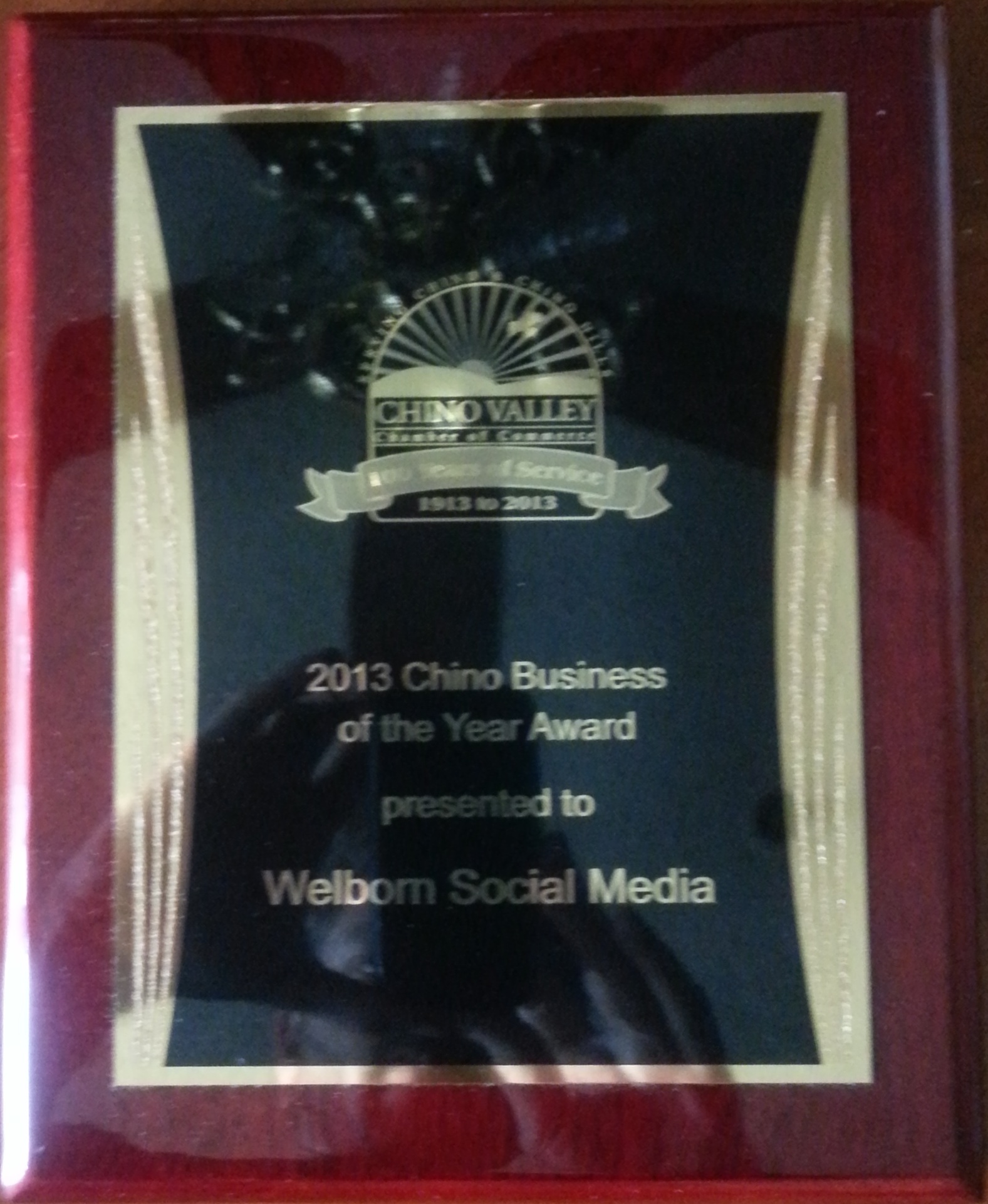
2013 Chino Business of the Year! – Welborn Social Media

On Friday, June 28 the Chino Valley Chamber of Commerce held its annual Installation & Awards Dinner at the Planes of Fame Museum in Chino, CA where they named Welborn Social Media the 2013 Chino Business of the Year.

Debbie Mitsch, the newly sworn in Chairman of the Board began the announcement, “The 2013 Chino Business of the Year was founded in 2011 and is very big in the social media world.” She went on to award Welborn Social Media as the Chino Business of the Year.

Lacey and I were completely surprised at being named the 2013 Chino Business of the Year and feel very fortunate that we were nominated and chosen by people and businesses that we respect and admire.

The Defining Success Podcast has really given us the opportunity to help our community and reach out to individuals and businesses who are doing great things.  Although we have won this award we still want to work hard to make a difference and impact the lives of others.  We do this by helping business owners share the passion they have for their business with as many people as possible using the tools of the Internet.

Upon receiving such an honor, more than anything, I feel thankful for everyone who has been involved with us along the way. We have worked hard in our business to provide the best service for our customers, but know deep down that it wouldn’t have been possible without the help of so many. Find out all about the experience here. 

Don’t hesitate to contact me if you have any questions about the Defining Success Podcast or Welborn Social Media – Share Your Passion.  Grow Your Business.

Welborn Social Media Named 2013 Chino Business of the Year

2013 Chino Business of the Year – Welborn Social Media

Facebooktwitterlinkedinmail